


According to data from BrightEdge in 2026, AI agents perform up to 88% of tasks performed by humans for organic search. That means that AI will soon become the primary gatekeeper to help evaluate and choose brands for consumers[1]. Right now. But most content creators are continuing to publish pieces that are optimized only for search bots, which no longer make decisions about who ranks on their own — artificial inference engines do.
The misalignment of effort from SEO professionals and the attention that matters? This is the crisis point. And a Generative Engine Optimization (GEO) checklist is no longer an optional asset — but rather a necessity.It’s time to come right out and say it: GEO is not just SEO with lipstick. There is an entire mindset shift required here, which many SEOs are grossly underestimating.
What GEO Actually Is (And What It Isn’t).
GEO, fundamentally, is the process of arranging your content in such a way that the large language model (e.g., Google’s AI Overviews, Perplexity, ChatGPT Search, and other AI assistants) would consider it worthy enough to quote, cite, or synthesize into an output.
This does not include things like click-through rate optimization, keyword stuffing, meta tags hacks, etc.
Where SEO aims for the top spot in the list, GEO wants you to get cited in an output. And this is where the differences between them come to play. Your SEO strategy may place you in the #1 spot, while 40% of the users who would be asking an AI assistant the same question answered by your content will not see your content there. Maddening? Yes. But fixable. Just not without knowing how it all works.
Introducing RAG for SEO — Retrieval-Augmented Generation, the technological principle behind most AI search engines today. Whenever someone asks Perplexity or Google’s AI Overviews a question, this AI assistant does not just go back to its pre-trained knowledge base. The machine pulls the pieces of text necessary to synthesize the answer and uses that content. What determines the eligibility of your content for retrieval? Not your PageRank
AEO vs GEO: Clear the Confusion First.

The phrase “Answer Engine Optimization” (AEO) is used in parallel with GEO. However, the approaches are different, and using the terms interchangeably will lead to misdirected efforts in your optimization strategy.
AEO is the older technique and is all about featured snippets, People Also Ask boxes, and voice searches. The essence of the approach is to present a well-formulated answer that can be easily extracted by Google to be presented in position zero.
On the other hand, GEO is a higher-level concept than AEO. While AEO focuses on answering one question, GEO seeks to make the content corpus answerable, reputable, and citable by inference engines that synthesize information from multiple sources to generate one answer. Thus, AEO tries to give the right answer to a question, whereas GEO aims to make the content authoritative enough to be used as a data source by inference engines while navigating through the semantic graph.
To summarize, the difference between AEO and GEO comes down to their objectives. While AEO focuses on creating an appropriate response, GEO focuses on creating credible data sources.
The Generative Engine Optimization (GEO) Checklist: 9 Steps That Actually Move the Needle.
Step 1: Run a Full AI Search Visibility Audit Before Anything Else.
Prior to optimization, it is essential that you identify where you stand within the AI-generated answer landscape. This is something that most SEOs overlook. This is a huge mistake.
The first step in an AI Search Visibility Audit is to search the AI engines (Google AI Overview, Perplexity, ChatGPT with search engine enabled, Bing Copilot) with the questions your content aims to answer and log how often your domain is mentioned, cited, and/or referenced versus your competitors.
Identify:
- The queries that trigger your website as a reference compared to other competing sites
- When your brand is mentioned in the AI-generated answer without any direct reference
- How the AI engines phrase their answer when citing your site
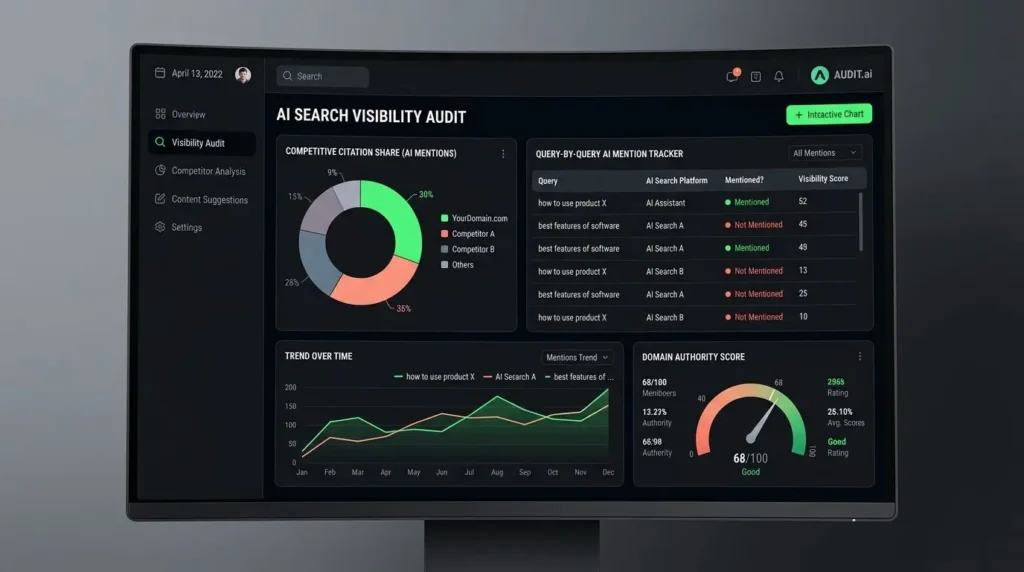
Conduct this audit manually for your top 20 target queries. It must be done manually because of the nuances that no automated solution can capture yet.
Once you have successfully identified your gaps in visibility, you’ll need the operational capacity to fill them. If you’re ready to move beyond basic AI use, check out our guide on using Claude for marketing automation to see how high-authority agencies are automating everything from content calendars to site audits.
Step 2: Restructure Content Around “Retrievable Chunks”.
The secret that very few SEOs would be willing to share is that RAG models have evolved from merely breaking down documents. In today’s era, the advanced technique used by these systems is contextual retrieval, which analyzes connections between the headers and the data points and identifies nodes of “High-Information Density.” [2]
This means practically that each large block of your writing must be able to stand alone. It must address a particular question, have all the context required to understand it without relying on earlier sections, and state things clearly.
Paragraphs which are vague and rambling and require context from other parts of the article to make sense? These are blind spots for retrieval. Write as if each individual H2 is going to be interpreted by the model separately from the rest of your article.
Step 3: Claim Your Expertise With First-Person Evidence.
Experience, which is what the “E” in E-E-A-T stands for according to Google’s latest addition, turns out to be yet another vital GEO signal for the AI system. AI systems tend to reward those sources more which present experience-based content instead of synthetic or compiled material from other sources [3].
Incorporate sections of personal experience. Provide case studies along with statistics. Give opinions along with logical reasoning. Observe and then state facts within a context.
It’s not about making things more relaxed and casual. It’s about providing an epistemic basis for the AI system to consider your content as a primary source.
Step 4: Deploy Structured Data Aggressively.
The schema markup isn’t simply there to tell Googlebot what’s going on with your page content. The schema markup gives clear semantic information that can be extracted by language model-powered engines when they crawl your pages [4].
Do the bare minimum of:
- Article Schema with Author, datePublished, dateModified, publisher, and mainEntityOfPage
- FAQPage Schema for any Q&A parts you have
- HowTo Schema for any process explanation
- Speakable Schema — highly overlooked but highly influential for voice search
Keep your schemas not only in place but current and accurate. Old dateModified dates are insidious trust killers.
Step 5: Build Semantic Density, Not Keyword Density.
This is where the fine points of using RAG for SEO comes into play. While embeddings are doing the heavy lifting of the retrieval process, they are not matching keywords — they’re matching intent vectors. And that means your content must address a topic with enough semantic depth to compete across a variety of queries.
In practice, that looks like:
- Addressing additional sub-topics within the article without being limited to only the targeted keywords
- Using synonyms, related topics, and conceptually connected terms naturally and without overthinking it
- Citing and linking to relevant outside sources — which can help bolster the semantic depth of your topical cluster

What it is not: Keyword stuffing’s next iteration. Overstuffed terms without substantial coverage will actively work against you.
Step 6: Answer the Question in the First Two Sentences of Every Section.
This seems insultingly obvious, yet few pieces of content manage to do so. Each heading that you include as part of your piece of content is, in essence, an open-ended question. Respond to that question within the first two sentences of the section itself.
Then expand upon your answer. Provide nuance.
Inversion, which is how most content writers approach answers, actually undermines retrievability. RAGs don’t have time to read all of that.
Step 7: Establish Off-Page Citation Signals.
How to get cited in AI Overviews Is Not Only About On-Page SEO Optimization. AI learns about the authority of your pages through citations of them from other authoritative sources. This is analogous to the concept of link building within the framework of the GEO theory and may even be more essential than it.
What you should do is:
- Gain legitimate mentions in trade press, academic literature, or scientific papers, and reputable editorial platforms
- Get included in selected compilations and expert directories relevant to your market segment
- Establish your company as an entity in external knowledge bases such as Wikidata
A single mention from an authoritative source in your domain may be worth hundreds of low-authority links. The standards in this case are exceptionally high.
Step 8: Maintain Content Freshness as a Non-Negotiable Signal.
AI-powered applications, especially those providing real-time search enhanced answers such as Perplexity and Google AI Overviews, display a marked inclination towards freshly updated pieces [5]. An article from 2022 that has not been modified since would be structurally disadvantaged, even if the facts provided in the article have not changed.
Create a content update schedule:
- Main topic pages: review and update every three months
- Numbers and statistics: update whenever a report providing the numbers has a newer version
- Structured data: confirm each time a major content update occursPut a Last Updated stamp on all articles.
This shows freshness both to readers and to the crawlers that provide training data feeds.
Step 9: Build Your GEO Measurement Framework.
The only thing you can manage is what you can measure. The problem is that there currently isn’t one place where all the data on AI citations can be found — you’ll need to create your own feedback loop.
| Query Category | Query String | AI Source | Cited? | Position | Sentiment |
|---|---|---|---|---|---|
| Informational | How to start GEO | ChatGPT | Yes | Body | Positive |
| Comparison | SEO vs GEO | Perplexity | No | – | – |
| Navigational | Vantagepick services | Google AI | Yes | Lead | Positive |
Monthly tracking proxies:
- Branded query volumes in Google Search Console (AI mentions frequently go through the roof here).
- Direct traffic from AI referers (Perplexity, ChatGPT) in GA4.
- Manual citation reviews for your top 20 queriesShare of voice in AI results compared to your top three competitors.
This will be messy. The measurement frameworks are lagging behind the way things actually work. That’s just a fact. Accept it and do the best with what you have.
The Common Mistake (And What to Do Instead).
One of the more common mistakes made by GEO practitioners is the idea of applying GEO to content, when in reality, GEO should be thought of as an architectural issue.
Groups create one optimized article and realize they don’t see citations, so they assume that GEO is not effective. The mistake here is that artificial intelligence systems are assessing the integrity of the entire topic domain – they aren’t assessing individual pages. If you have a well-optimized page surrounded by a content ecosystem that is weak and poorly organized, the page itself will not be detected by the inference engines that make assessments.
Instead, what you need to do is to use GEO as a strategy at the level of the site as a whole. Map out the full content architecture of your website relative to how it aligns with authoritative clusters identified by AI technology, and optimize accordingly.This takes longer. But it works.
In My Experience: Managing Vantagepick in the AI Search Era.

Operating a digital brand in 2026 requires dealing with issues that did not arise three years prior – and some of those issues are quite bizarre indeed.
For instance, with Vantagepick, the technical challenges arose much sooner than anticipated. Creating the perfect SEO title in the face of constant evolution of AI-powered Google Overviews entailed painstakingly analyzing all possible variations of how a particular title would render across SERPs. Character count limits and device-specific rendering rules created a situation where perfect titles looked just terrible in one variation. It is not a content issue – it is the problem of underlying technical infrastructure that took a significant amount of time.
Another issue that arises in the GEO landscape is indexing delays for high-quality content. While Google Search Console displays it as being “discovered and currently not indexed,” there are no crawl issues or any manual actions taken against the website. Such content, in a standard SEO environment, would be annoying but manageable. Not so in the GEO world: an unindexed page is both non-indexed by organic algorithms and AI-driven systems – the entire retrieval chain cannot cite something not yet processed by the system.
For us, the move to GEO wasn’t one of philosophy; it was a matter of survival. While organic click-through rates on informational queries were dropping, our ranking positions weren’t moving. The clicks were being sucked up by the level above that in the stack – the answers produced via artificial intelligence. If we hadn’t made the change to optimize not only our ranking positions but also that which lay above, we’d now be experiencing something closer to a slow death.
What led to a pivot in direction: thinking about content in terms of evidence rather than copy. In other words, considering every piece we published not in terms of its value to a human user reading the SERP page, but as potential material for an AI algorithm to pick up and use as a citable, retrievable piece of information. This affected everything from our subheads to our author entity maintenance.
It’s more difficult than SEO used to be. The feedback loops are longer and less clear. However, not making a move meant leaving everything in terms of AI-generated answerability to competitors who were already working on it.
The Uncomfortable Truth to Close On.
GEO isn’t something you mark off one time and put in the bottom drawer. It’s an ongoing operational stance, where you’re always working to make your content ecosystem machine-readable, semantic, and epistemic.
The winners in AI-powered search today aren’t necessarily more intelligent than anyone else. They simply got an early start and iterated faster. Nothing more, nothing less.
There’s still time to stake out topical dominance within AI inferencing systems before your space becomes saturated, but it’s running out quietly, just like all good windows do.
Begin the audit. Perform the checklist. Evaluate the signals. The effort itself is the edge.