


A McKinsey Global Institute analysis found that companies bleed up to 30% of their annual revenue directly to process inefficiency — not from bad strategy, not from weak market positioning, but from avoidable operational drag [1]. Thirty percent. For a $10M company, that’s $3 million dissolving in the background every single year while leadership discusses Q3 pipeline in yet another 90-minute meeting.
Here’s what nobody says out loud: most of that waste isn’t a systems problem. It’s a culture problem.
You can buy the fanciest project management software, hire a Six Sigma Black Belt, and rename your workflows three times over. If the people running those workflows don’t believe that operational efficiency is their job — every day, not just during an all-hands initiative — you’ve invested significant money to produce better-looking waste. That’s the uncomfortable truth most consultants won’t lead with, because it implicates leadership as much as it implicates process.
So let’s fix that.
Why Culture Eats Process for Breakfast
Peter Drucker’s most misquoted line — “culture eats strategy for breakfast” — wasn’t designed for motivational posters. It was an observation about institutional behavior: how people actually work when no one’s auditing them will always override a written procedure document.
The same principle governs operations. A beautifully formatted SOP is worth nothing if the team quietly skips step four because it “always seemed unnecessary.” That’s not laziness. That’s cultural drift. And culture, unlike software, doesn’t ship with an update patch.
Gallup’s State of the Global Workplace report put the productivity cost of actively disengaged employees at $8.9 trillion globally [2]. Trillion with a T. Not all of that is pure operational waste — but a substantial slice is employees doing work the hard way, duplicating effort, or ignoring faster paths because they have no personal stake in improving them.
Operational efficiency without employee buy-in is theater. You can reduce it to a formula:
Efficiency Theater = New Tools + No Cultural Alignment
It looks productive. It measures fine. And it costs you enormously.
The 7-Step Framework for Genuine Operational Efficiency
Before we get into the steps — and they are genuinely sequential, don’t skip — understand one foundational thing: this isn’t a sprint. Companies that treat operational efficiency as a single-quarter initiative consistently underperform companies that treat it as a permanent operating philosophy — Bain & HBR research tracking dozens of major transformation programs found that only 12% produce lasting results [3]. Toyota didn’t build the Toyota Production System in a fiscal year. Neither will you. But you have to start somewhere, so here’s where.
Step 1: Conduct a Brutal Waste Audit
Not a polite one. A brutal one.
Lean methodology — in its modern organizational adaptation — categorizes waste into eight classic muda types: overproduction, waiting, unnecessary transport, over-processing, excess inventory, unnecessary motion, defects, and underutilized talent [4]. That last category is the most expensive and the least scrutinized. Skilled people doing low-leverage work is an operational efficiency crisis hiding in plain sight, and most org charts are full of it.

Run a real audit against each category. For every core business process, ask:
- Where does work queue up and wait on a human decision that could be pre-decided?
- What gets done twice because the first pass wasn’t trusted?
- Which approval layers exist because of a problem that stopped being relevant two product cycles ago?
- Where does $120/hour talent spend time on tasks that a $15/month automation handles in seconds?
Document everything. Don’t fix yet. The compulsion to leap to solutions before you’ve catalogued the full scope of problems is precisely why most operational audits deliver marginal, short-lived results.
The truth is, finding ‘waste’ is only half the battle. If you audit your workflows and stop there, you’ve just documented your own failure. To actually move the needle, you have to automate the fixes. I’ve seen lean teams try to manual-task their way out of a bottleneck, but it never scales. If that’s where you’re stuck, you should check out my breakdown on AI Implementation for Small Business—it’s the exact roadmap I’d use to turn those manual headaches into hands-off systems.
Step 2: Map the Real Workflow, Not the Aspirational One
There’s the workflow in the handbook. Then there’s the workflow that actually happens. They are — without exception, in every organization I’ve encountered — never the same thing.
Shadow your team. Not to police them; to understand the informal adaptations they’ve built to compensate for friction in the official process. Those workarounds aren’t insubordination — they’re data. They tell you exactly where the system design failed the people it was supposed to serve. Business process automation built on an idealized workflow will automate the wrong process and manufacture new bottlenecks downstream, which is an expensive and demoralizing outcome.
MIT’s Sloan Management Review found that companies who mapped actual versus prescribed workflows before digitizing their operations reduced implementation failure rates by nearly 40% [5]. That statistic deserves a full stop and a moment of reflection before anyone signs a software contract.
Step 3: Separate Signal from Noise in Your Operational Efficiency Metrics
This one is uncomfortable. Most teams measure what’s easy to measure, not what matters.
Vanity metrics for operations — tasks completed, hours logged, emails sent — create a statistical illusion of productivity. Real operational efficiency metrics track output quality, cycle time, first-pass yield rate, and cost per unit of value delivered. Those four. If you’re measuring something else, ask why.
Here’s the litmus test: if improving a metric doesn’t demonstrably improve either customer outcomes or cost structure, it’s almost certainly noise. Retire it.
To move beyond vanity metrics, track your First-Pass Yield (FPY). This measures the percentage of tasks completed correctly the first time without needing rework.
This draws from OKR methodology — Objectives and Key Results — popularized at Intel under Andy Grove and later scaled at Google [6]. The discipline isn’t in setting ambitious goals. It’s in the ruthless removal of measurements that carry no load-bearing connection to actual outcomes.
Step 4: Automate Strategically, Not Reflexively

Business process automation is frequently sold as the silver bullet for operational waste. It isn’t — and applying it prematurely is one of the most reliably expensive mistakes an organization can make.
The correct sequencing is non-negotiable:
- Identify the process and its current state
- Simplify it to its leanest defensible form
- Standardize it so outputs are predictable and consistent
- Then — only then — automate it
Inverting steps three and four, automating before you’ve standardized, is the single most common and costly error in operational transformation. I’ve watched it sink implementations that cost mid-market companies north of $500K in licensing fees, integration work, and the lost productivity that comes with migrating to a new platform that runs the wrong process faster than before.
When the groundwork is done correctly, though, the ROI on business process automation is material. Deloitte’s Intelligent Automation Survey found that organizations with mature automation programs reported average cost reductions of 31–32%, with those that have fully scaled RPA believing automation can absorb up to 52% of transactional FTE capacity — freeing people for higher-leverage work [7]. Those aren’t incremental gains. That’s the kind of structural advantage that compounds across quarters and widens a competitive gap.
Step 5: Build Psychological Safety Around Inefficiency Reporting
This step is where most operational efficiency frameworks completely collapse. And I’d argue it matters more than any of the preceding ones.
If your team is afraid to say “this process is broken,” the process will stay broken indefinitely. Fear of appearing incompetent — or appearing implicitly critical of a senior person who designed the process — produces an organizational silence that is operationally catastrophic. You end up with people performing increasingly elaborate workarounds while nodding in meetings that the system is working fine.

Amy Edmondson’s research at Harvard Business School on psychological safety — the theoretical foundation of her landmark book, The Fearless Organization — consistently demonstrates that teams in high-safety environments identify and resolve operational failures faster and more completely than those operating in punitive cultures [8]. The mechanism isn’t complicated: when people feel safe flagging friction, friction gets flagged early. When they don’t, it compounds for months before it becomes a crisis.
Practically, this means:
- Celebrate the person who identifies a bottleneck, not just the one who fixes it
- Make process feedback a standing agenda item in team meetings — not an annual engagement survey
- Never, under any circumstances, let a post-mortem become a blame session; the second it does, you’ve destroyed six months of psychological safety-building
- Model vulnerability from the top: leaders who openly acknowledge flawed processes in their own domain give everyone else permission to do the same
Step 6: Apply Lean Management for Startups (and Scaleups) Correctly
Lean management for startups isn’t a scaled-down version of the Toyota Production System. It’s a fundamentally different application, one that must account for the reality that your processes are still being invented while you’re running them. That’s not a deficiency — it’s simply the operating condition of any fast-moving organization.
The lean principles that translate cleanly into early-stage and growth-stage environments:
- Continuous improvement (Kaizen): Small, frequent process refinements compound dramatically over time. A 1% efficiency improvement per week produces roughly a 67% annual improvement in that process [9]. Most teams underestimate this because the early gains feel trivial.
- Pull-based workflow: Work initiates based on downstream demand, not upstream assumption. This eliminates overproduction and the invisible “inventory” of unfinished, half-completed tasks that clog team capacity.
- Visual management: Kanban boards, cycle-time tracking, explicit WIP limits. Making workflow visible is the prerequisite for making it better — you cannot improve what you cannot see.
- Gemba walks: Senior leadership spending time where actual work happens. Not in boardrooms theorizing about operational efficiency; in the Slack channels, on support calls, in the sprint reviews — watching the work occur in real conditions.

The lean management approach for startups differs from enterprise applications primarily in cadence. Faster feedback loops, smaller batch sizes, and a higher tolerance for process ambiguity during the refinement phase. The mistake is trying to achieve enterprise-level process formalization at Series A scale — it produces rigidity that kills the adaptive capacity you need most.
Step 7: Make Operational Efficiency a Universal KPI
Not just the operations team. Not just the COO. Everyone with a direct report and a budget.
When sales doesn’t measure handoff quality to customer success, the handoff is systematically bad. When engineering doesn’t track deployment frequency and change failure rate, deployments stay chaotic. When HR doesn’t monitor time-to-full-productivity for new hires, onboarding remains a vague experience that differs by manager.
Operational efficiency is a whole-organization metric. The moment it becomes the exclusive accountability of an “ops team,” you’ve guaranteed suboptimal results across every function they don’t directly control. Cross-functional efficiency KPIs create the accountability architecture that sustains efficiency culture when the initial energy of a new initiative fades — and it always, always fades without structural reinforcement.
🚀 The “Day One” Reality Check
Theory is cheap. If you want to see if your operational culture is actually breathing, run these three tests in the next 24 hours:
- ✅ The 15-Minute Ask: Find a frontline team member. Ask: “Which part of our ‘official’ process do you skip because it’s a waste of your time?” Listen to the answer without getting defensive.
- ✅ The Calendar Audit: Look at your next three meetings. If there isn’t a documented “Next Action” or a clear agenda, cancel them immediately or fix them. No more talking in circles.
- ✅ The Vulnerability Signal: Admit to your team that one specific process personally frustrates you. It breaks the “theater” of perfection and gives them permission to be honest about bottlenecks.
The Most Common Mistake — and What to Do Instead
The mistake: treating operational efficiency as a cost-reduction exercise.
It isn’t. Or rather, it shouldn’t be — and framing it that way is reliably counterproductive.
Companies that position efficiency primarily as a way to cut headcount or reduce expenditure create a workforce that’s perpetually anxious about being “optimized out.” The irony is brutal: anxiety destroys the precise productivity they’re trying to protect. Deloitte’s Human Capital Trends research found that organizations primarily driven by cost-cutting efficiency programs saw employee performance decline by an average of 14% in the following 18 months [10].
The reframe that actually works: efficiency as capacity creation. The goal isn’t to do the same work with fewer people. It’s to do more — better quality output, faster delivery, higher-leverage work — with the same or comparable resource base. That framing lands differently at every level of an organization. It creates forward momentum instead of defensive posturing. It positions improvement as a growth mechanism, not a contraction mechanism.
Reframe your internal communications accordingly, and watch the energy in the room change.
In My Experience: What Actually Shifts the Culture
Having worked across organizations from Series A startups to established mid-market firms on operational transformation projects, here’s the most consistent pattern I’ve observed — the one that doesn’t show up cleanly in any framework.
The single greatest predictor of a sustainable operational efficiency culture isn’t the sophistication of the tooling, the consulting budget, or the quality of the process documentation. It’s whether the most senior person in the room treats their own workflow with the same rigor they’re asking of everyone else.
Nothing kills an efficiency initiative faster than the person driving it being visibly chaotic. If the COO championing lean management runs meetings without agendas, sends Slack messages at midnight that contradict decisions made in last Tuesday’s all-hands, and can’t articulate their top three priorities for the quarter — people notice. They don’t say anything (see: Step 5). But they quietly conclude that operational discipline is for the organizational layers below them.
The behavioral logic here is straightforward. Efficiency culture requires psychological buy-in, and buy-in requires credibility. Credibility requires consistency between what’s asked and what’s modeled. Leaders who publicly submit to the same process discipline they’re requiring of others — who share their OKRs openly, who do their Gemba walks, who audit their own workflows in team settings — send an unmistakable cultural signal.
That’s where genuine efficiency cultures take root. Not in the software stack. In the behavior at the top. It sounds obvious when you read it. It’s extraordinarily rare in practice.
The Role of Business Process Automation in a Mature Efficiency Culture
Let’s be precise about where business process automation fits in the maturity arc, because it’s regularly introduced at the wrong stage.
Automation — whether you’re deploying RPA, AI-augmented workflows, or simpler conditional logic through tools like Make or Zapier — delivers maximum value at the sustain phase, not the design phase. Its function is to lock in efficiency gains already achieved through human refinement, and to handle the high-volume, low-variance tasks that consume disproportionate bandwidth from people who should be working on harder problems.
The categories where business process automation consistently delivers fastest ROI:
- Data entry and validation: Pure volume tasks with low cognitive load and defined parameters
- Approval routing: Structured decisions that follow consistent, auditable rules
- Reporting and dashboards: Information assembly following repeatable logic across stable data sources
- Customer communication triggers: Sequenced outreach based on clearly defined behavioral conditions
- Compliance documentation: Audit trail generation and records management with defined retention logic
What automation doesn’t fix: judgment-heavy coordination, cross-functional negotiation, and anything requiring contextual interpretation of ambiguous inputs. Attempting to automate those functions prematurely is how you end up with a customer-facing chatbot that infuriates users and an RPA bot that breaks every time someone modifies a column header in a shared spreadsheet — both of which I have personally witnessed in organizations that were otherwise excellent at many things.
The sequencing discipline from Step 4 applies here too. Standardize first. Automate second.
The Compounding Return on Efficiency Culture
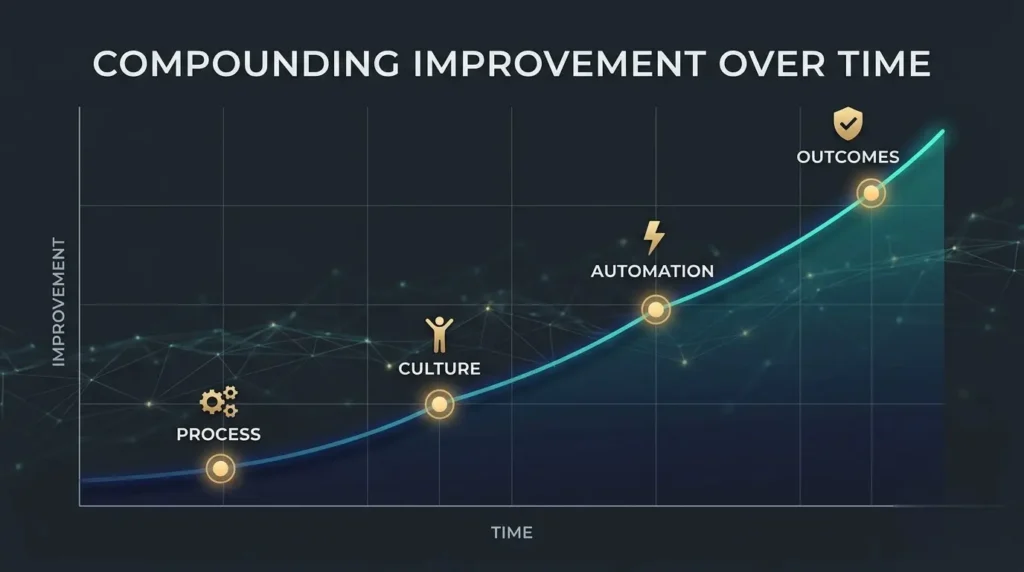
Here’s what makes this worth the sustained investment: operational efficiency improvements compound in ways that most financial models fail to capture.
A 15% reduction in cycle time isn’t just a cost saving — it’s a capacity increase that allows the same team to serve more customers, deliver more features, or pursue more opportunities without proportional headcount growth. A 10% reduction in rework doesn’t just save labor hours — it improves product quality, reduces customer churn, and lowers the support burden simultaneously.
When these improvements are embedded in culture rather than bolted onto it, they sustain between initiative cycles. They don’t require a new consultant engagement every 18 months to reinstate. The organization’s baseline level of operational efficiency rises permanently, and each subsequent improvement starts from a higher floor.
That’s the actual prize. Not a one-time cost reduction. A permanently elevated operating baseline that your competitors — who are still running the same broken workflows they had three years ago — are not starting from.
Closing Thought
Operational efficiency isn’t a destination your organization arrives at and then maintains on autopilot. It’s a posture — one that either becomes instinctive and organizational, or quietly atrophies the moment an initiative loses its executive sponsor.
The companies that sustain genuine operational efficiency over years aren’t the ones with the most sophisticated tooling or the most rigorous SOP libraries. They’re the ones where asking “can we do this better?” is genuinely welcomed at every level. Where process improvement is everyone’s job title. Where leadership models the discipline it demands.
Build that culture. The efficiency follows.
I’ve worked with organizations from Series A startups to mid-market firms, and the bottleneck is rarely the talent—it’s the “theater.” Which of these 7 shifts feels like the biggest hurdle for your team right now? Let’s discuss in the comments.