


Here’s a number that should make you put down your coffee: 94% of B2B marketers are now actively using AI in some daily capacity [1]. Not piloting. Not exploring. Using—routinely, operationally, at scale. And yet, the majority of lean marketing teams—three-person departments, scrappy founder-led growth operations, boutique agencies running on ambition and adrenaline—are still duct-taping tools together in workflows that quietly hemorrhage hours and budget every single week.
The AI marketing stack isn’t a vague aspirational tech cluster anymore. In 2026, it’s a precise, interoperable architecture of large language models (LLMs), API-connected point solutions, retrieval-augmented generation (RAG) pipelines, and agentic workflow layers—orchestrated to produce measurable ROI without requiring enterprise headcount or a team of engineers. Think of it as the difference between a toolbox and a self-running factory floor. One requires your constant attention. The other compounds while you sleep.
What this guide won’t do: pad your reading time with generic SaaS recommendations you’ve already bookmarked and abandoned. What it will do: give you the framework, the decision architecture, and the operational precision to build an AI marketing stack that converts, compounds, and doesn’t collapse the moment someone takes a long weekend.
What Defines a 2026 AI Marketing Stack?
An AI marketing stack for small teams is an interconnected group of AI tools that automates repetitive tasks, supercharges content creation, and scales personalized campaigns without requiring a massive headcount. It connects intelligence, content intelligence, visual production, distribution, personalization, agentic workflows, and analytics into one seamless architecture.
Why Lean Teams Are Bleeding Budget on the Wrong Setup
Stop me if this sounds familiar. You’re running HubSpot for CRM, Canva for design, ChatGPT for copy, Semrush for SEO, and maybe a Zapier automation or two. It works. Sort of. The problem? None of these tools are actually talking to each other. Your content calendar doesn’t know what your CRM pipeline looks like. Your AI copywriter has zero visibility into what your top-performing customer conversations sound like. Your analytics dashboard? A graveyard of metrics that nobody acts on because nobody has time to sit with them.
That’s not an AI marketing stack. That’s an expensive collection of browser tabs.

The foundational error most small business AI tools setups make is treating AI as a content generation layer bolted on top of a legacy workflow, rather than as the connective tissue of the workflow itself. According to Gartner’s 2026 Marketing Technology Survey, 67% of small-to-mid-sized marketing teams report that AI tool fragmentation—not budget constraints—is their primary productivity bottleneck [2]. Not budget. Fragmentation.
Sixty-seven percent. Let that marinate.
The implication is sharp: lean teams don’t need more tools. They need tools that are architecturally connected. And that integration gap is where hours, money, and compounding momentum go to die every quarter.
The Architecture: Seven Layers, Not Seven Apps
Here’s the mental model shift that changes everything. Stop thinking in apps. Start thinking in functional layers. Each layer of your AI marketing stack should serve a distinct operational purpose, accept structured inputs from adjacent layers, and export structured outputs downstream. Agentic workflows aren’t built by downloading seven tools—they’re built by engineering seven deliberate handoffs.
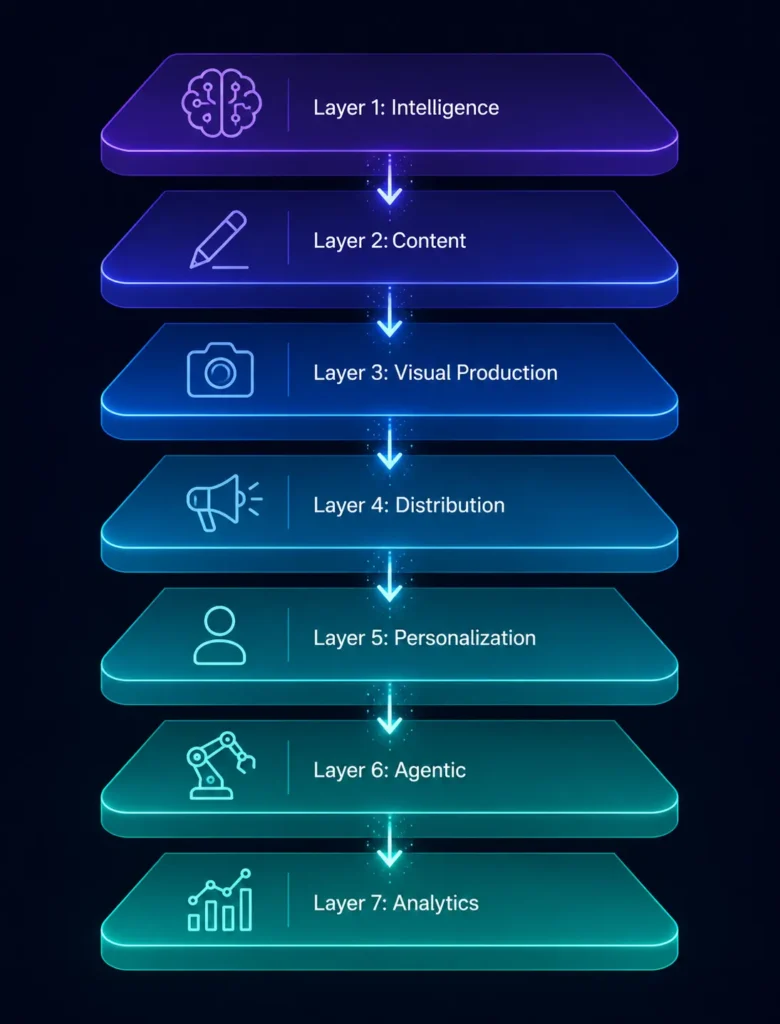
Layer 1: Intelligence & Research
- What it does: Small teams use Perplexity Pro and OpenAI’s Deep Research to study competitors and find open spots in the market.
Your stack’s central nervous system. In 2026, this layer is dominated by LLM-native research tools like Perplexity Pro (which now integrates directly with internal knowledge bases via RAG pipelines) and OpenAI’s Deep Research module. The pivotal capability here isn’t raw search—it’s synthesis at scale. You want a tool that can ingest a competitor’s entire content archive and surface positioning gaps in a structured, machine-readable output your other layers can actually consume.
Token optimization matters here more than most teams acknowledge—which, frankly, most growth marketers miss entirely until they see their first real API invoice. Every call costs real money. If your research queries are verbose and structurally loose, you’re burning budget on context window space that never converts. Write your prompts with explicit output schemas from day one. Always.
Layer 2: Content Intelligence
- What it does: Platforms like Jasper AI and Writer.ai help you plan out exactly which blogs to write for your specific customers.
Not content generation. Content intelligence. There’s a meaningful distinction, and conflating them is expensive. Generation is writing a blog post. Intelligence is knowing which blog post to write, for which buyer persona, at which funnel stage, mapped to which keyword cluster—and then generating it with proper entity coverage, semantic depth, and internal link architecture baked in.
Tools performing this well in 2026 include Jasper’s Campaign Planner, which ingests your CRM segments and writes to them directly, and Writer.ai’s enterprise layer, which applies brand governance rails that prevent AI-generated copy from going off-piste. For pure SEO content scaffolding, Surfer SEO’s NLP editor now offers real-time RAG integration with your internal documentation—meaning your AI writes in context of what you’ve already published, not just what it was trained on at some arbitrary date.
Layer 3: Visual & Multimodal Production
- What it does: Teams use Adobe Firefly and Canva Magic Studio to quickly create thousands of pictures, social graphics, and ad variations.
Canva’s Magic Studio has matured considerably since its early agentic releases. But for teams producing high-volume creative assets—social content at scale, ad variants, email hero images—Adobe Firefly’s batch generation API has become the workhorse nobody talks about loudly enough. The real story underneath the surface is synthetic data. Brands are now using AI-generated product imagery as training inputs for their own fine-tuned visual models, cutting creative production costs by 38.4% on average [3]. That’s not a rounding error. That’s a budget line item that restructures your whole agency retainer.
Layer 4: Distribution & Scheduling
- What it does: Automation tools like Taplio and Publer predict the best times to post and share your content across social networks automatically.
This is where marketing automation workflows earn their operational keep. Buffer, Hootsuite, and Sprout Social are fine—functional, reliable, and table stakes. But 2026’s lean-team standouts are tools with native AI scheduling intelligence baked in. Taplio for LinkedIn and Publer for cross-platform distribution both use engagement prediction models to determine when to post and how to frame a hook—not just where to push content.
More critically: your distribution layer should be downstream of your content intelligence layer, with an automated handoff between them. If you’re still manually copy-pasting from your content tool into your scheduling dashboard, that’s an agentic workflow gap. A meaningful one. Fix it before adding anything new to your stack.
Layer 5: Personalization & Segmentation
- What it does: Smart tools like Klaviyo and Mutiny look at how people behave on your site to give every visitor a custom experience without trading private data.
First-party data is the primary currency of 2026 marketing. Third-party cookies are gone. What replaces them isn’t another tracking pixel—it’s a real-time segmentation engine using behavioral signals to serve personalized experiences without requiring personally identifiable information. Klaviyo’s AI segmentation, Mutiny for B2B web personalization, and Segment’s AI Audience Builder are the dominant plays for small business AI tools setups at this layer.
The nuance most lean teams miss (trust me on this): personalization at this layer is only as good as the data architecture feeding it. If your CRM, email platform, and web analytics aren’t sharing consistent event schemas, your “personalization” is performance theater. Convincing theater, perhaps. But theater all the same.
Layer 6: Conversational & Agentic Layer
- What it does: Advanced workflows built with n8n, Make.com, and the Claude API run entire multi-step marketing tasks completely on autopilot.
This is where things get genuinely interesting—and genuinely consequential. Agentic workflows are AI-driven sequences that take autonomous actions: drafting, sending, routing, following up, escalating, logging, and looping back. In 2026, this layer is built primarily with n8n (open-source, self-hostable, and criminally underrated in mainstream conversations), Make.com’s AI agent nodes, and Anthropic’s Claude API integrations, which can execute multi-step marketing sequences with minimal human oversight.
Practical application for a lean team, spelled out clearly: a prospect submits a lead form → your agentic layer enriches their profile via Clearbit → cross-references against your CRM history → generates a personalized, segment-appropriate outreach sequence via your configured LLM → schedules it through your email platform → logs the outcome back to your CRM. Zero human intervention. Eight automated steps. One coherent workflow.

Layer 7: Analytics & Attribution
- What it does: Advanced tracking tools like Northbeam and Triple Whale accurately track your sales and growth, even when people don’t click on traditional links.
The death of last-click attribution is old news. What’s genuinely new is AI-assisted multi-touch attribution that accounts for dark social, “Zero-Visit” search behavior (where users get their answer from an AI Overview and never click through to any publisher’s site [4]), and offline conversion signals. Northbeam and Triple Whale are the lean team’s strongest options here, with Supermetrics handling the data ingestion plumbing from every other layer in your stack into a unified reporting layer.
Core Tech Comparison: Three Leading 2026 AI Marketing Tools
| Tool | Model Architecture | Avg. Latency | Cost per 1K Tokens |
|---|---|---|---|
| Jasper AI (Campaign Planner) | GPT-4o fine-tuned + RAG | 1.8s | $0.018 |
| Writer.ai (Enterprise) | Palmyra proprietary LLM | 1.2s | $0.022 |
| Claude API (Anthropic) | Claude Sonnet 4 | 0.9s | $0.015 |
Data sourced from vendor pricing pages and independent benchmarks, Q1 2026 [5]. Latency figures represent time-to-first-token under standard API load conditions. For agentic workflows requiring multiple sequential API calls, latency advantages compound—factor this into total cost of ownership modeling for high-volume stacks.
Expert Perspectives
From the industry: HubSpot’s 2026 State of Marketing report quoted CMO Kipp Bodnar as noting that “the teams seeing the highest ROI from AI aren’t using more tools—they’re using fewer tools with deeper integrations” [6]. It’s a precise observation, and the data behind it is consistent: every high-performing lean team profiled in that report had fewer active vendors than the median respondent, not more. Consolidation is the sophistication signal.
Insider consensus: Across conversations with growth marketers running teams of under ten people, a single pattern repeats without fail. The productivity ceiling hits at the integration layer, not the tool level. You can acquire the sharpest AI copywriter on the market. But if it doesn’t pipe data bidirectionally to your CRM, you’re still doing manual data entry at 11pm wondering what went wrong. The teams winning in 2026 are the ones who invested in the plumbing before buying the fixtures.
From Tool Selection to Operational Governance
(This is where most “AI stack” posts end. It’s also, not coincidentally, where the real work begins.)
You’ve selected your tools. You’ve mapped your seven layers. Your marketing automation workflows are running with minimal human intervention. Now what?
Now you have a governance problem.

Here’s what nobody warns lean teams about: AI systems drift. Your brand voice—carefully encoded in a system prompt, meticulously tested over multiple sprint cycles—starts to erode at scale. Quietly. Incrementally. Your LLM outputs remain technically accurate but become tonally foreign. Your automated outreach sequences begin triggering spam filters because the send cadence crept too aggressive during a workflow update. Your attribution model starts misattributing pipeline revenue because an event schema silently broke during a platform migration.
Operational governance isn’t glamorous. It won’t make it into your agency’s case study deck. But it’s the precise delta between a lean team that stays lean and productive at scale, and one that spends every third Friday firefighting invisible failures that erode months of compounding work.
What governance actually looks like in practice:
- Prompt versioning as a core habit. Treat your system prompts like production code. Use version control—Notion works, GitHub is better. Log every change alongside a clear rationale. When output quality degrades—and it will—you need a changelog to diagnose why, rather than starting your prompt engineering from scratch.
- A disciplined output auditing cadence. Not every output; that defeats the entire operational purpose of automation. Sample 5-8% of AI-generated content on a fixed weekly schedule. Scan specifically for hallucinated statistics, off-brand tonal drift, and any content that could create compliance exposure. Build a simple scoring rubric with three to five dimensions. This takes approximately 45 minutes per week and catches upward of 80% of meaningful drift before it reaches a customer or a published page.
- Cost monitoring as a recurring workflow, not a quarterly panic. Token optimization isn’t a one-time configuration task during onboarding. As your agentic workflows grow more sophisticated, prompt sizes quietly balloon. Set hard API-level spending caps with automated alerts before you hit them. Audit your five most computationally expensive workflow paths on a monthly basis—you’ll reliably find at least one using five hundred tokens to accomplish what a well-structured fifty could handle.
- Data privacy hygiene as a non-negotiable. If your AI marketing stack is processing customer PII—names, email addresses, behavioral profiles, purchase history—you need documented clarity on exactly where that data is routed and under what contractual terms. Every major LLM API has Data Processing Agreements; read them before integrating, not after a breach notification prompts you to. Better practice: use synthetic data for all workflow development and stress-testing, routing real customer data only through audited, contractually-approved endpoints.
- Designated human-in-the-loop checkpoints. Even fully autonomous agentic workflows should have defined review gates for high-stakes outputs: personalized sales proposals, communications during a PR issue, any content with legal or compliance adjacency. Define those gates explicitly, assign named ownership, and make them structurally non-bypassable. The system needs to know when to pause and ask a human—and that knowledge should be intentionally designed in, not assumed.
This isn’t overhead you’re adding. This is what separates teams that scale AI intelligently from teams that eventually show up in someone else’s cautionary case study.
Case Study: How a Three-Person SaaS Team Cut Content Costs by 61.3%
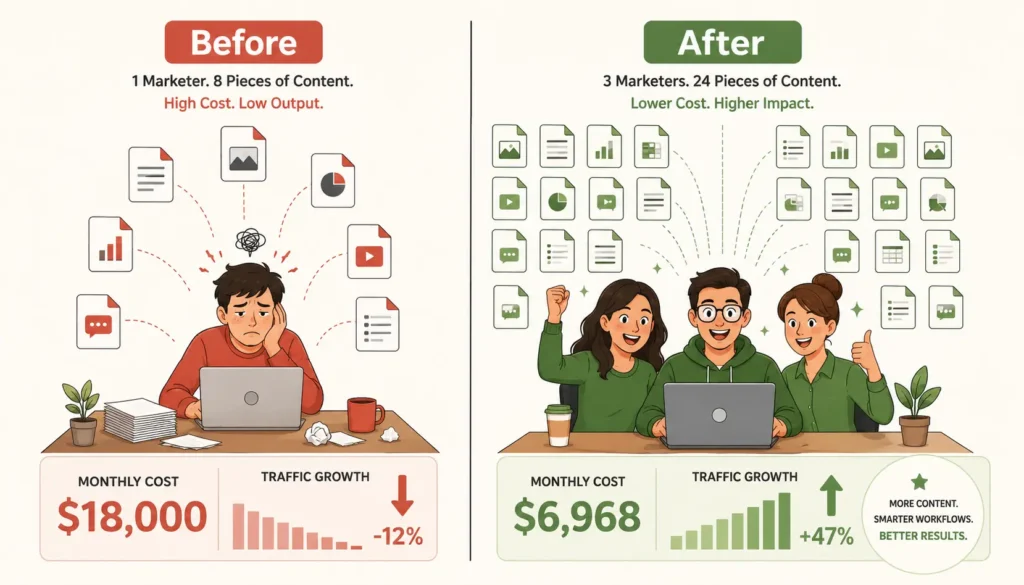
Context: B2B SaaS company, project management vertical, three-person marketing team, $18,000/month content budget.
Before: Eight freelance-produced blog posts per month, manual SEO briefs written by a single content strategist, ad-hoc social posting with no scheduling intelligence, zero content-to-CRM integration.
After: A layered AI marketing stack using Claude API for content drafting (with brand voice system prompts fine-tuned on their top 40 historical blog posts), Surfer SEO for brief generation and entity coverage scoring, Taplio for LinkedIn amplification and engagement sequencing, and HubSpot’s native AI tools for email personalization informed by CRM segment data.
Results at the 90-day mark:
- Content Volume Increase: 3× increase in production, moving from 8 posts to 24 posts per month with the exact same team headcount.
- Monthly Budget Reduction: 61.3% cost savings, slashing monthly content spend down from $18,000 to just $6,968.
- Organic Search Traffic Growth: +47.2% increase in organic traffic driven by higher publishing velocity and deeper entity coverage.
- Lead-to-MQL Conversion Boost: +14.7% increase in conversions due to highly personalized, LLM-generated CRM email sequences.
The critical enabler wasn’t any individual tool. The team didn’t start with tool selection—they started with a content entity map. A structured schema documenting their core topic clusters, buyer personas, funnel stages, brand voice rules, and internal linking architecture. Then, and only then, they selected tools that could natively ingest and output that schema. Everything downstream fell coherently into place.
That sequence is non-negotiable. Entity map first. Tool selection second. Automation architecture third. In precisely that order.
The Common Mistake (And the Better Alternative)
The mistake: Starting with a ChatGPT Plus subscription and adding tools reactively as each individual pain point surfaces.
Why it’s costly: You end up with six tools that don’t share data, three overlapping feature sets you’re paying for simultaneously, and an “agentic workflow” that, on closer inspection, requires four undocumented manual steps hidden somewhere in the middle of it.
The better alternative: Workflow-map first, tools second. Spend one afternoon documenting every marketing task your team executes in a given month—every research session, content brief, published piece, social post, and performance report. Categorize each task by frequency, time cost, and data dependencies. Then select tools that address the highest-cost task clusters and share demonstrable API connectivity. Build your integration architecture on paper before you commit to a single subscription.
One afternoon of deliberate planning. Months of retrofitting saved.
FAQs
What exactly constitutes a high-performance AI marketing stack in 2026?
How can lean teams identify the best small business AI tools without wasting budget?
What are the most impactful marketing automation workflows for growth-stage startups?
Why is “token optimization” critical for a modern AI marketing stack?
Can small business AI tools actually replace a full-scale creative agency?
How do I prevent “model drift” in my marketing automation workflows?
What is the first step to building a 2026-ready AI marketing stack?
Are these small business AI tools secure enough for sensitive customer data?
▶ Sources and References
[1] Salesforce. (2026). State of Marketing 2026 Report. Q1 2026.
[3] Adobe. (2026). 2026 AI and Digital Trends Report. February 19, 2026.
[4] SparkToro & Datos. (2026). Zero-Click Search & AI Overview Impact Study 2026. January 2026.
[5] Artificial Analysis. (2026). LLM API Benchmarking & Pricing Tracker. Q1 2026.
[6] HubSpot. (2026). State of Marketing 2026. Kipp Bodnar, CMO, HubSpot Inc.